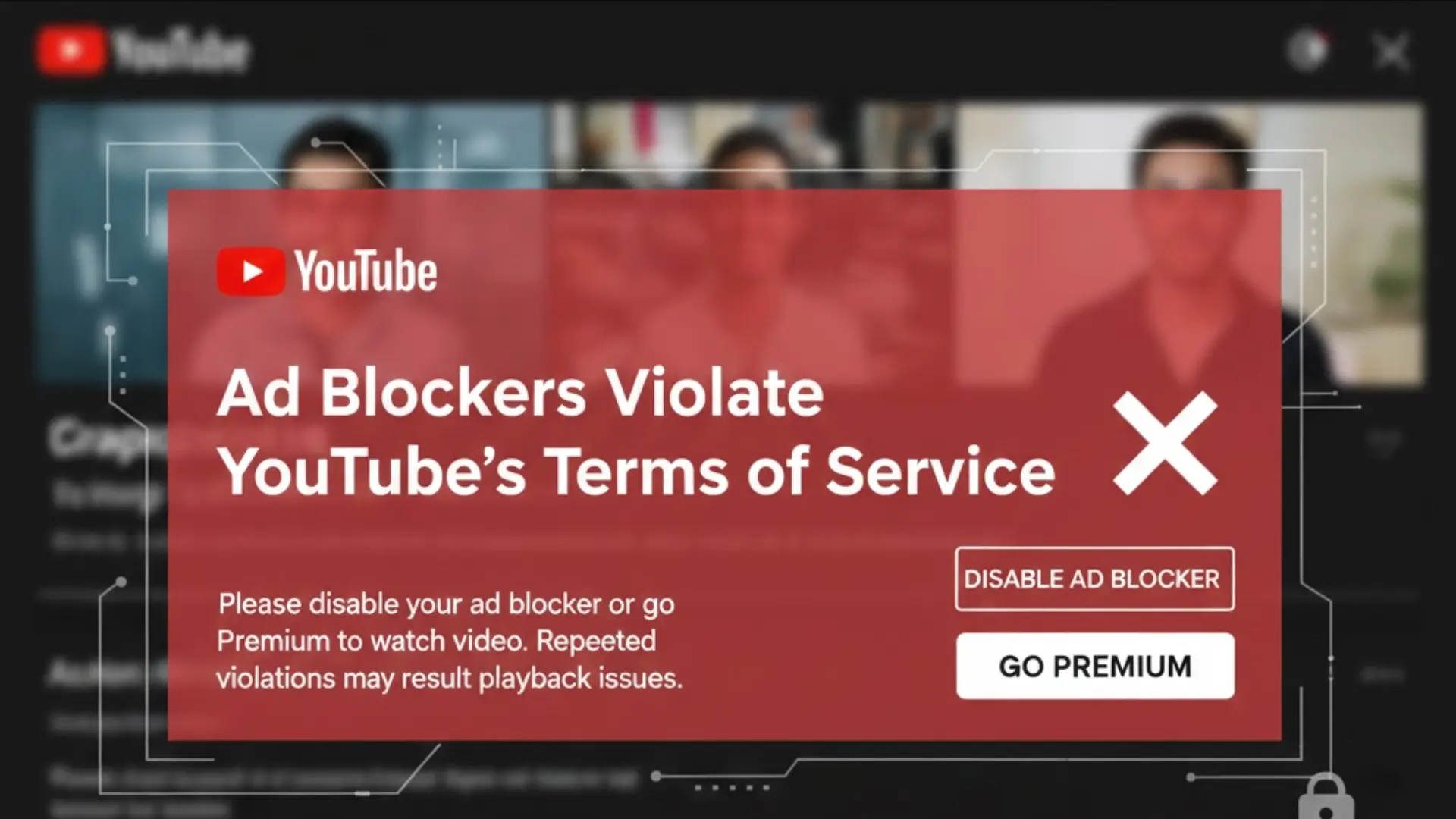
Do you click play on a YouTube video only to be stopped by a warning telling you to turn off your ad blocker or subscribe to YouTube Premium?
In case this is the case, then you are witnessing a calculated move in the way YouTube imposes its regulations. This message is not haphazard or by chance. It is also one of a wider strategy that has been long-established and came into much more focus in 2025.
When it comes to funding YouTube, Advertising is a huge source of revenue that finances YouTube, creators, and infrastructure. Alphabet has been consistently reporting high earnings that indicate that advertising constitutes over three quarters of the total earnings of YouTube. At the scale of ads being blocked, that type of business model becomes weak, and YouTube reacts by gaining a better grip on the usage of its service.
Users now have a choice to make between tolerating ads or switching to paid subscription.
This article breaks down what this change actually entails, why it has come about and the implications such change has on anyone who uses adblock on YouTube.
What “Ad Blockers Violate YouTube’s Terms of Service” Actually Means
It is not saying that ad blockers are illegal when YouTube writes that they do not comply with its Terms of Service. It is platform messaging and not the law. In most countries, ad blockers are legal and users are usually given the freedom to regulate what runs on their browsers.
In YouTube’s view, ad blocking interferes with its business model. When ads are blocked, the service cannot be delivered in the way described under the Terms of Use. This gives YouTube the contractual authority to respond, even if the ad blocker itself is legitimate.
This is where many users get confused when searching phrases like “ad blockers violate youtube’s terms of service no adblocker.” Legality and platform permission are not the same thing. A tool can be lawful to use while still violating the rules of a specific service.
In practical terms, YouTube is not banning ad blockers outright. It is setting conditions for access. When those conditions are not met, YouTube may stop playback, display warnings, or require users to allow ads or subscribe to YouTube Premium to continue watching.
How YouTube’s Anti-AdBlock Strategy Evolved From 2023 to 2025
The anti-adblock strategy by YouTube was implemented in phases, with each phase meant to push boundaries, gauge the behavior of the users, and mount pressure, but not in such a way that it would bring a backlash among people. Instead of prohibiting ad blockers, YouTube paid attention to their slow implementation, which is strictly related to the monetization objectives.
Ready to join top,
Early 2023: Initial Warnings and Behavioral Testing
- YouTube started displaying banners that the Ad blockers were not permitted although it continued letting most of the users watch videos.
- This was aimed at observing and not enforcing so that YouTube could quantify compliance, error rates, and user sentiment.
- Countdown timers were provided in a few tests so as to generate a sense of urgency without the access being blocked immediately.
Mid to Late 2023: Introducing Friction Instead of Bans
- If the ad blockers remained enabled, YouTube threatened users that their viewing of YouTube videos would be blocked after a fixed number of videos.
- The strategy appealed to habitual viewing tendencies, which were based on inconvenience as a source of behavior change as opposed to an outright ban.
- The posts on Reddit and browser forums became more frequent which means wider experimentation and more credible detection.
2024: Expansion and Monetization Alignment
- Anti adblock was implemented in more regions, devices, and logged-in accounts.
- Detection was not only transformed to ad request checks, but it was changed to layered signals, such as playback behavior and script execution.
- The communication was putting YouTube Premium as the white hat to ad blocking.
Early 2025: Explicit Enforcement Through Terms of Service
- The warning language changed to state clearly that ad blockers violate YouTube’s Terms of Service.
- Some users were able to have playback blocking that was more quicker and reliable.
- It was more affected in Firefox and Opera, which fits the trend of Chrome into Manifest V3 and weaker extensions.
The New 2025 Anti Adblock Banner Explained
The anti adblock banner of 2025 can seem like previous warnings, but its language and purpose represent a distinct change in the enforcement approach adopted by YouTube. Instead of stating that ad blockers are not allowed, the banner now says that ad blockers violate YouTube’s Terms of Service, framing ad blocking as a direct breach of platform rules rather than a discouraged behavior.
What Changed in the Messaging
- The term is no longer a recommendation and requires no interpretation as to whether ad blocking is acceptable.
- The message should also have an explicit mention of the Terms of Service, which studies on compliance psychology have demonstrated provides user acceptance.
- The liability is put on the user, which indicates that further access will be subject to accepting the terms of YouTube.
Design and Behavioral Influence
- The button to “Allow YouTube ads” is graphically highlighted whereas the button to “Try YouTube Premium” is less so.
- This design is based on the traditional research of interfaces that indicate that users are drawn to highlighted actions when there is an interruption.
- The design is very similar to previous 2023 banners, indicating the improvement of an efficient strategy instead of an experiment.
Where and How the Banner Appears
- User reports have increased visibility in Firefox and Opera, which still have more robust extensions blocking adverts.
- The banner is not universal, meaning it is not rolled out universally but selective enforcement.
- Such small scale testing has enabled YouTube to optimize detection accuracy and reduce false positives to large scale deployment.
Why Firefox and Opera Users Are Affected More Than Chrome
- A high number of users report more such warnings and playback disruption on Firefox and Opera, and fewer such warnings or delayed actions on Chrome users.
- Such difference is feasible due to the browser extensions architecture rather than user behavior, particularly the movement of Chrome to the newer framework of Manifest V3.
- Manifest V3 limits how extensions can block network requests and scripts, reducing the effectiveness of many adblock for YouTube tools by default.
- This already results in weaker adblocking by Chrome users, which reduces the necessity of YouTube to impose aggressive anti adblock enforcement.
- Firefox and Opera are keeping up with Manifest V2, which offers the opportunity to control the network traffic much more deeply, filter the cosmetics, and block scripts.
- These more powerful capabilities help ad blockers with Firefox and Opera to be more effective but more noticeable to the detection tools with YouTube.
- In the case of YouTube, Ad blockers are more effective with stronger ad blocking, so these browsers become higher priorities to test.
- Ownership is also important, as Google has direct control over Chrome, and thus YouTube has a seat in the behavior of extensions in its own browser.
- YouTube can strategically exert pressure without inconveniencing the majority of its audience by enforcing on smaller browsers that have a higher ad blocking percentage.
How YouTube Detects and Blocks Ad Blockers
YouTube is based on a stacked detection system as opposed to a trigger. The platform examines the behavior of the ads, videos and scripts in combination, searching and finding trends that indicate that the ad is being blocked rather than played.
Some of the major signals that YouTube tracks are
- Lacking ad requests when loading a video or interrupted.
- Script behavior that is disruptive to the delivery of ads or the tracking.
- Patterns of playback which avoid pre roll or mid roll advertisements are too clean.
- Delay in video calls and ad calls between video and ad calls.
YouTube can signal the failure of ads to load repeatedly, so the website might provide warnings or block play. In other instances, the platform creates artificial delays or playback checks to verify that the ads are being blocked, as opposed to them being skipped.
This system is effective since no one signal is adblocking. YouTube uses a combination of technical data, behavior pattern, and consistency of the session to reduce false positives and complicate simple filter based blocking in long term long run.
Server Side Ad Insertion and Why It Changes Everything
The trend of server side ad insertion at YouTube is one of the most important developments in the battle against adblocking. In contrast to the traditional advertisements that are loaded independently of the video content, the server side advertisements are embedded into the video stream before the content gets to the user. The ad and the video look like one file to the browser and it is much harder to separate.
This approach changes the technical balance in several ways
- The use of ad blockers can no longer depend on the blocking of individual ad requests.
- The deletion of ads may jeopardize the video playback altogether.
- The ads appear like normal contents, which makes them harder to identify.
- The system reflects the existing ads within the mobile applications of YouTube.
Streaming platform industry research indicates that server ad insertion raises the ad completion rates by over twenty percent over client-side delivery. Although YouTube is in the process of testing this approach on desktop, its gradual implementation points to a long term plan which is all about resilience and not short term enforcement ambitions today.
Does Ad Blocking Still Work on YouTube in 2025
In YouTube, ad blocking continues to be effective in 2025, depending upon configuration, browser and frequency of update. YouTube is more about disrupting, not preventing, and effectiveness is determined by the rate at which tools adapt.
The most common tools that continue to be partially successful are
- uBlock origin with regularly updated blocklists.
- AdGuard Browser Extension and desktop applications.
- Brave Shields which include inbuilt filtering.
- Windows or Mac Network level blockers like AdGuard.
The restrictions that users are facing are emerging as
- Blocked and warning banners of playback.
- Ads within the video streams.
- Lower performance on Chrome with Manifest V3.
The objective of YouTube is not to eliminate but friction. The interruption makes users conform or subscribe. This seems to be working as Alphabet records show that YouTube premium subscribers have steadily increased up to 2024 and even early 2025 in spite of adblockers usage by the users who want to see less ads without having to pay monthly fees online.
How Users Are Bypassing YouTube’s Adblock Restrictions
Users have not stopped using adblock for YouTube, but their behavior has shifted toward lighter, less permanent workarounds. The majority of the techniques are aimed at evading arrest and not completely overcoming it, and almost all of them are limited or less convenient on the whole.
- Updated Filter Lists: Users update blocker filter lists regularly to keep up with detection evolutions, but fixes tend to break a few weeks later.
- Private Browsing Sessions: Cloaked or secretive sessions may or may not circumvent archived detection flags, however, the outcomes are not always consistent and often not reliable in the long run.
- Browser Switching: Others compare Chrome, Firefox and Opera to users who are testing the difference in enforcement but some are not always successful as the policies keep changing.
- Third Party Frontends: Other interfaces such as Invidious minimize the number of ads, although they usually do not have features, stability, or reliability.
- System Level Blocking: Network level blockers completely block ads on both apps and browsers, and are more comprehensive but can be more difficult to install and have higher technical knowledge requirements.
YouTube Premium vs Ad Blockers The Business Motivation
As a business, Youtube position on ad blocking is business-based and not user-oriented. There are also two main lines of monetization in the platform that rely on the display of ads in one form or another.
- Advertising Model: Advertising is also the biggest source of income to YouTube. Advertisements finance the platform infrastructure, payment to creators, content moderation and recommendation engines. In cases where ad blockers cause complete removal of ads, this model fails to work and the result is a direct loss of revenue with no compensatory effect.
- Subscription Model: YouTube Premium does not show ads to users and creators are paid depending on the time watched. This makes it predictable and recurrent revenue that is less difficult to predict and scale to YouTube. Financially, the value of Premium users to ad blocking users is much greater.
Why Ad Blockers Conflict With Both Models: Ad blockers do not result in revenue, do not offer a opportunity to pay creators, and bypass both monetization avenues, at the same time. This renders them disruptive in a unique way, as opposed to free or paid users.
Legal and Ethical Perspective on YouTube Adblocking
- In most countries, ad blocking devices are not yet illegalized, and the courts have tended to find that the users have the right to decide what content should be displayed within their respective browsers or devices.
- The enforcement of YouTube is not in a legal sense, owing to the fact that terms of accessing the platform are not regulated by the law but by the Terms of Service.
- An ad blocker is not a crime or civil offense, although it may infringe the usage terms of YouTube, which grants the platform the authority to limit users.
- In ethical terms, there are arguments of intrusive advertising being detrimental to the experience of the user, and arguments of ads subsidizing creators and making content free.
- Social media such as YouTube weighs user choice against sustainability, and is typically more eager to support revenue models that sustain infrastructure and production of content.
- The issue is a wider clash of consumer agency and platform power that the conflict eventually represents, and there is no evident ethical agreement that is likely to be achieved.
What the Future Holds for YouTube and Ad Blocking
- Expansion of Server Side Advertising: YouTube will probably make using server side ad insertion in desktop and connected devices more widespread, making advertisements more difficult to disassociate with video content, which will decrease the usefulness of traditional adblocking techniques.
- Browser Level Enforcement: This implementation will be brought nearer to the browser level, especially with Chrome and Manifest V3, where the functionality of extensions has already been minimized and allowed by YouTube to better fit its terms.
- Deeper Platform Integration: Stricter correlation between Chrome and YouTube can enable enforcement to occur earlier in the playback process preventing workarounds that can be based on script timing or network filtering.
- Subscription Driven Monetization: YouTube will keep testing Premium pricing, bundling and region plans, where adblocking pressure will direct users to paid plans compared to ad revenue only.
Conclusion The Reality of YouTube and Ad Blocking
The message that YouTube sends when ad blockers are used that ad blockers are in violation of its Terms of Service indicates that YouTube is taking a definite move in protecting its business model. The ecosystem is supported by advertising and subscriptions to make content free to the viewers and sustainable to the creators, which is why it has become more direct and less lenient in enforcement.
Meanwhile, ad blocking is not going. Consumers are still seeking ways of managing their viewing scenarios particularly as commercials are increasing in frequency and difficulty to ignore. This is a tension that is in the ongoing process and not a result. YouTube is exerting pressure on policy, design, and technology and the users are modifying through tools, workarounds and alternative platforms.
The outcome is neither a winner nor a loser, but a constantly shifting equilibrium with enforcement and opposition keeping online video consumption as it is.
Frequently Asked Questions FAQs
Are ad blockers illegal on YouTube?
No. Ad blockers are legal means in the majority of countries. YouTube is not enforced by the criminal or civil law but rather its Terms of Service.
Why does YouTube say ad blockers violate its Terms of Service?
The advertisements are a fundamental aspect of the operation of YouTube and a source of revenue. Ad blocking is disruptive of such a model, which, according to YouTube, is a breach of its usage policies.
Can YouTube block videos if I use an ad blocker?
Yes. YouTube may freeze or block videos, show warning banners, or force them to either turn on advertisements or subscribe to YouTube Premium to access the video.
Why do ad blockers work better on Firefox than Chrome?
Firefox continues to use Manifest V2 that enables more aggressive ad blocking. The transition of Chrome to Manifest V3 restricts the capability that extensions have to block advertisements and make them less effective.
What is server side ad insertion on YouTube?
Server side ad injection embedded the ads into the video stream. This complicates the act of blocking ads since they are part of the video but not individual requests.
Is YouTube Premium the only way to avoid ads?
It is only officially possible to remove the majority of ads using YouTube Premium without breaching the Terms of Service of YouTube. Other techniques can still be employed but are becoming limited.
Will YouTube completely stop ad blocking in the future?
A full shutdown is unlikely. YouTube is interested not in complete elimination but in friction and ad blockers are constantly being improved to keep the cycle going.