



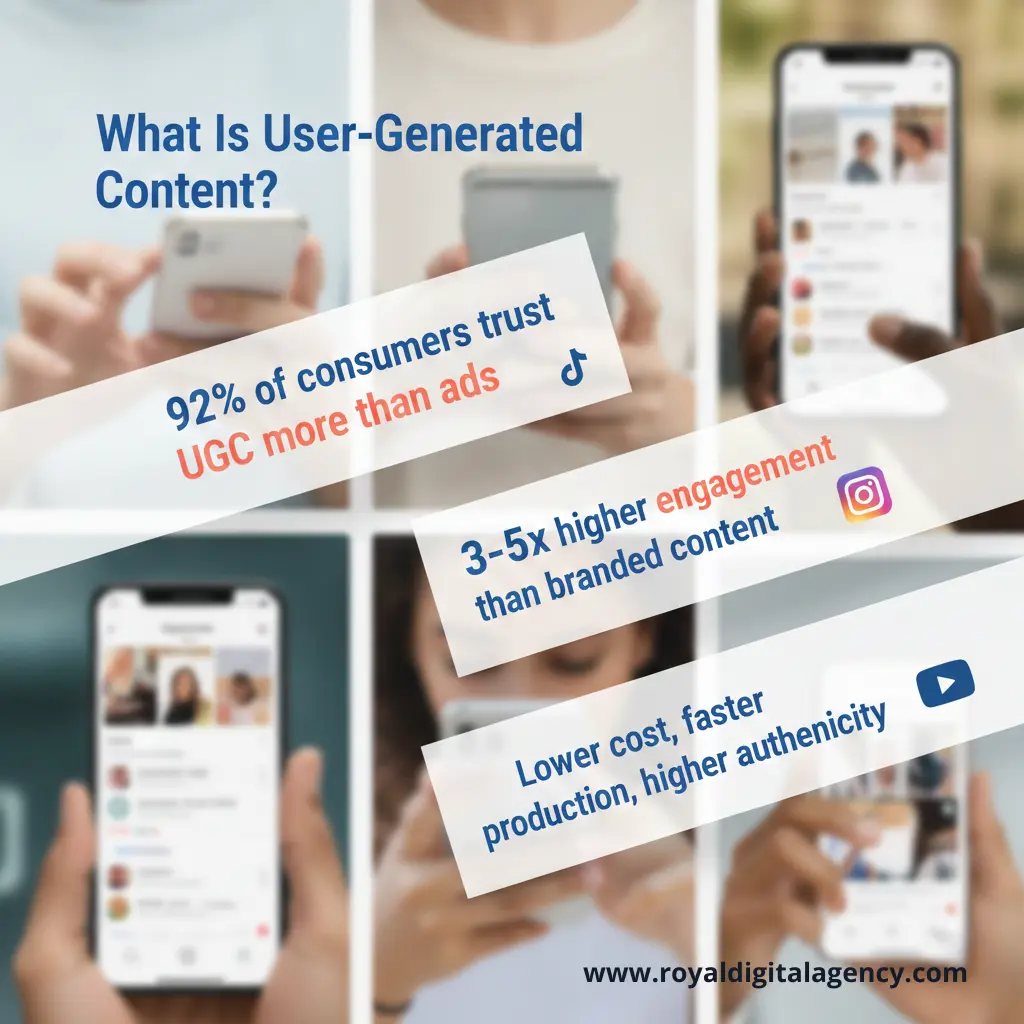
Long-standing industry studies by Nielsen and Stackla have shown that over 92 percent of customers believe user-generated content over traditional advertising. Meanwhile, brands are now spending up to 3 times as much on paid social ads as they would have a few years ago, and the attention spans are getting shorter.
This creates a clear problem.
Brands need more content.
They need it faster.
And they need it to feel real.
Traditional UGC campaigns are having difficulties keeping pace. Creators can cost hundreds or thousands of dollars per video and weeks to deal with. Such a model is no longer applicable to new-day marketing.
AI-powered UGC platforms solve this gap. These tools assist brands and creators in creating authentic-looking UGC brand videos within minutes and not weeks. They are now very popular in advertising, education, product introductions and social media development.
In this guide, you will learn how AI UGC works, how to start UGC using these tools, and which UGC platforms for creators and brands lead the market in 2026.
User-generated content or UGC is the content that gives an impression that a specific piece was written by an individual, not a company. It appears natural, spontaneous and sincere. It is precisely what makes it so effective.
UGC for brands usually appears as:
UGC does not attempt to impress, unlike polished ads. It tries to relate.
Studies have always recorded that UGC motivates 3 to 5 times more engagement as compared to traditional brand content. It is rewarded by platforms since it delivers naturally into feeds of the user. It is believable to people as it sounds human.
That trust is why user-generated content websites and UGC platforms for creators have become essential tools for modern marketing.
UGC functions by imitating the current way of communication by people on the internet. An effective UGC video is presented in a straight forward pattern:
For brands, UGC content sites help collect, manage, and reuse content from customers. To producers, UGC sites allow easy creation of social ready videos without huge budgets or crews.
In 2026, most brands are also making UGC-style videos more quickly using AI-powered tools. These tools adhere to the principle of authenticity, brevity and platform-native design.
In AI-based UGC platforms, videos are generated so that they feel and resemble an actual user-generated content, yet no human developers are engaged. They abide by the same principles that have rendered UGC effective authenticity, simplicity and platform-native design.
It is a simple process. You begin by giving a brief script, product description or product link. You specify purpose also, whether ads, social-posts, event promotion, or e-learning contents. The platform then applies artificial intelligence to produce an equivalent of typical UGC video.
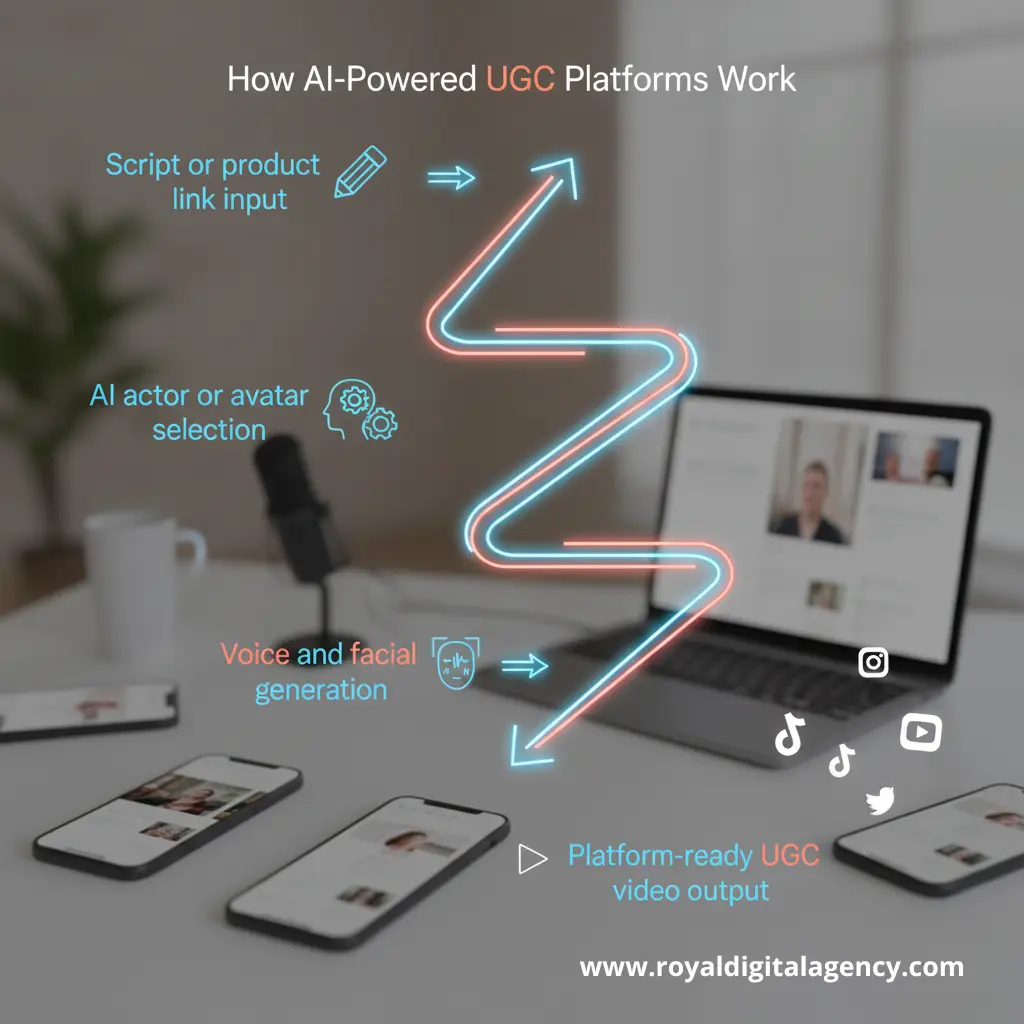
Most tools create:
Some UGC platforms for creators analyze product pages to auto-generate scripts, while others focus on AI-powered messengers that deliver influencer-like content. Additionally, there’s a growing advocate for bulk creation to test variations, a strategy commonly supported by Content Marketing Services to optimize engagement and conversion.
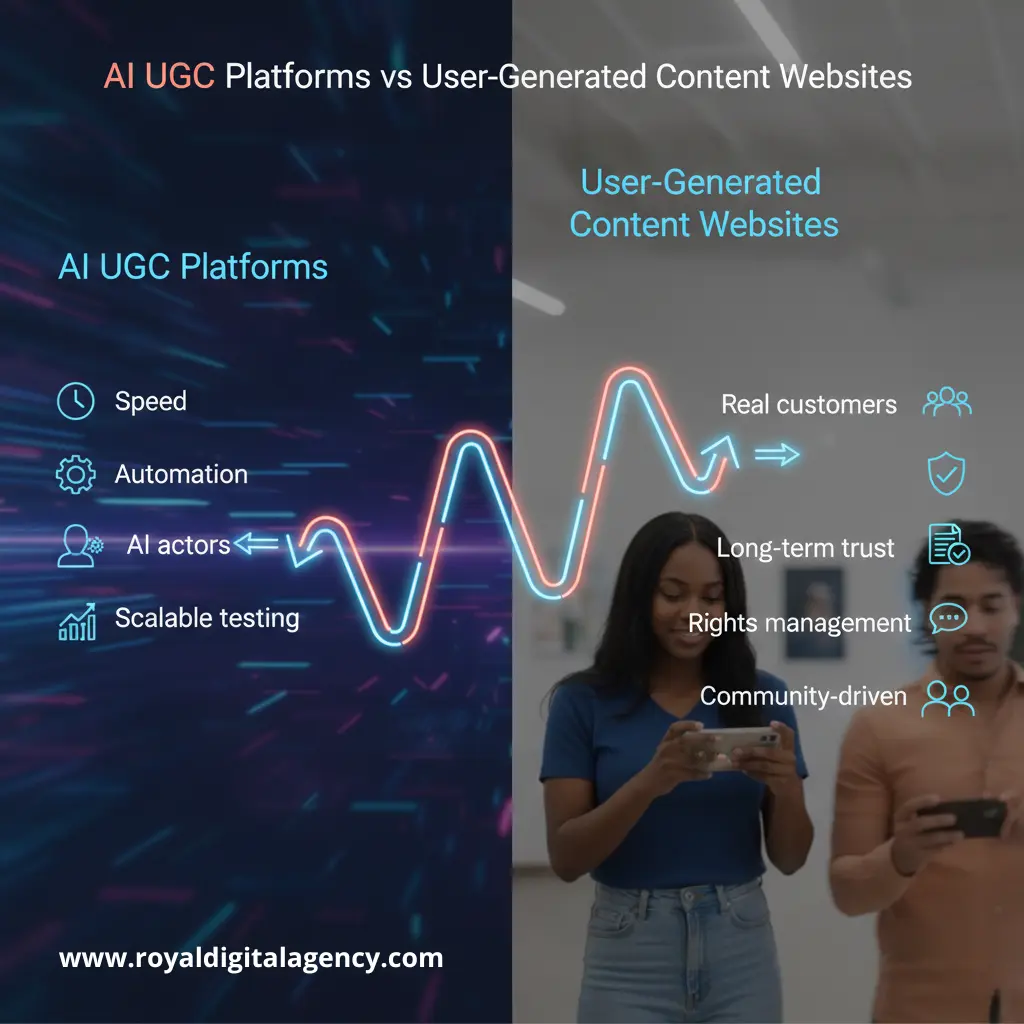
Unlike traditional user-generated content websites that collect real customer videos, AI UGC platforms generate new content on demand. In most cases, brands receive full commercial rights, making these tools practical for scalable UGC for brands in 2026.
AI UGC platforms and user-generated content websites serve different roles, even though both support UGC for brands and creators. This difference is important in business because it makes businesses get the correct tool.
These instruments are concerned with speed, volume and consistency. They come in particularly handy when the brands require content prior to the actual customer reviews.
Traditional UGC content sites rely on organic participation. The AIs UGC sites are based on automation.
In 2026, many brands combine both. AI tools handle fast production, while user-generated content websites provide credibility. This two-way strategy can assist brands in scaling the UGC content in an efficient manner and retaining trust across platforms.
The tarditional UGC campaigns require planning, recording, and approving to take weeks. AI-driven UGC technologies generate brand-ready videos within minutes. Such speed helps brands to test ideas fast and act on trends before they get out of fashion.
Cost is another major factor. A single creator could cost hundreds or even thousands of dollars per video. Most AI UGC platforms cost less than one creator post per month, making UGC for brands more accessible.
AI UGC is widely used by:
AI does not exclude the use of human creative power. It eliminates latency, reduces cost or makes user-generated content easier to scale.
When you do not aim at perfection but at clarity, it will be easy to start UGC with AI platforms.
Begin with one clear goal.
Select advertisements, social messages, or education. This makes your message to the point.
Next, pick one AI UGC platform. Utilizing excessive tools simultaneously is a drag and a distraction.
This is a practical procedure, which follows:
Most UGC platforms for creators make this process beginner friendly. No technical skills and editing experience are required.
The key is authenticity. UGC is effective when it is nonchalant and sincere. AI just enables you to create User Generated Content cheaper, better and at scale in 2026 to brands.
These are the most trusted AI UGC platforms that will be used by brands and creators in 2026. Every tool relies on scalable, genuine-looking user-created content to promote advertisements, education and social development.
Invideo AI helps the brands in developing real-world UGC brand content with AI actors, product imagery, and social-first formats being created with performance marketing and e-commerce development in mind.
Best for: E-commerce Brands producing high-performing UGC ads at scale.
Pros:
Cons:
Key Features:
Creatify specializes in transforming product URLs into many UGC-style video advertisements in a short time, which makes it popular among performance marketers who are experimenting with a large amount of creative variations.
Best for: Ad testing on e-commerce brands of high volume.
Pros:
Cons:
Key Features:
Arcades AI generates UGC advertisements with AI actors who are trained with real human models, and the ads target natural delivery and performance-based creatives in their Metas and Tik Tok campaigns.
Best for: Paid social UGC advertisements on Meta and Tik Tok.
Pros:
Cons:
Key Features:
Tagshop AI transforms product pages and turns them into the testimonial-like UGC videos, which mix product-analysis with AI scripting to promote the localised and multilingual UGC campaigns.
Best for: Brands that generate UGC video localization based on product URLs.
Pros:
Cons:
Key Features:
Zeely AI provides a mobile-first model to UGC creation which is AI video creation paired with campaign automation to small businesses and individual creators.
Best for: UGC creation on the mobile platform and easy campaign automation.
Pros:
Cons:
Key Features:
MakeUGC is focused on realistic AI testimonials in which the avatars physically hold, use, or consume tangible items, which would be suitable to DTC and product-based brands.
Best for: UGC as physical product testimonials and demonstration.
Pros:
Very realistic pictures of products in holding and use.
Vibrant testimonial-based video products.
Cons:
Key Features:
Mirage studio develops completely synthetic talking-head videos that are realistic in emotion, so it is more popular in tutorials, explainers and educational UGC.
Best for: Education and explainers Talking-head UGC videos.
Pros:
Cons:
Key Features:
The creators can use Argil AI to create personal AI clones and allow founders and educators to scale the UGC-style videos with a constant personal brand image.
Best for: Creater and founder personal brand UGC automation.
Pros:
Cons:
Key Features:
Pippit AI targets e-commerce sellers who require the fast and automatic creation of UGC videos based on Shopify and Tik Tok Shop product listings.
Best for: UGC video automation on Dropshipping and Shopify.
Pros:
Cons:
Key Features:
Vidnoz AI repurposes existing social proof by transforming written reviews into avatar-led testimonial videos, to assist brands to capture this type of social proof into video-based UGC at scale.
Best for: Transforming written reviews into plain UGC videos.
Pros:
Cons:
Key Features:

The selection of the appropriate UGC platform will be based on the way you intend to create, run, and expand content. This is because questions can be used to ask the right questions and avoid tools that may seem good on paper but fail on a practical application.
UGC videos go viral, as they seem authentic, not scripted. Individuals scroll over polished advertisements, yet they stop when content appears to be a real-life experience. This is why UGC for brands consistently outperforms traditional advertising formats across social platforms.
UGC that is doing well has a distinct pattern.
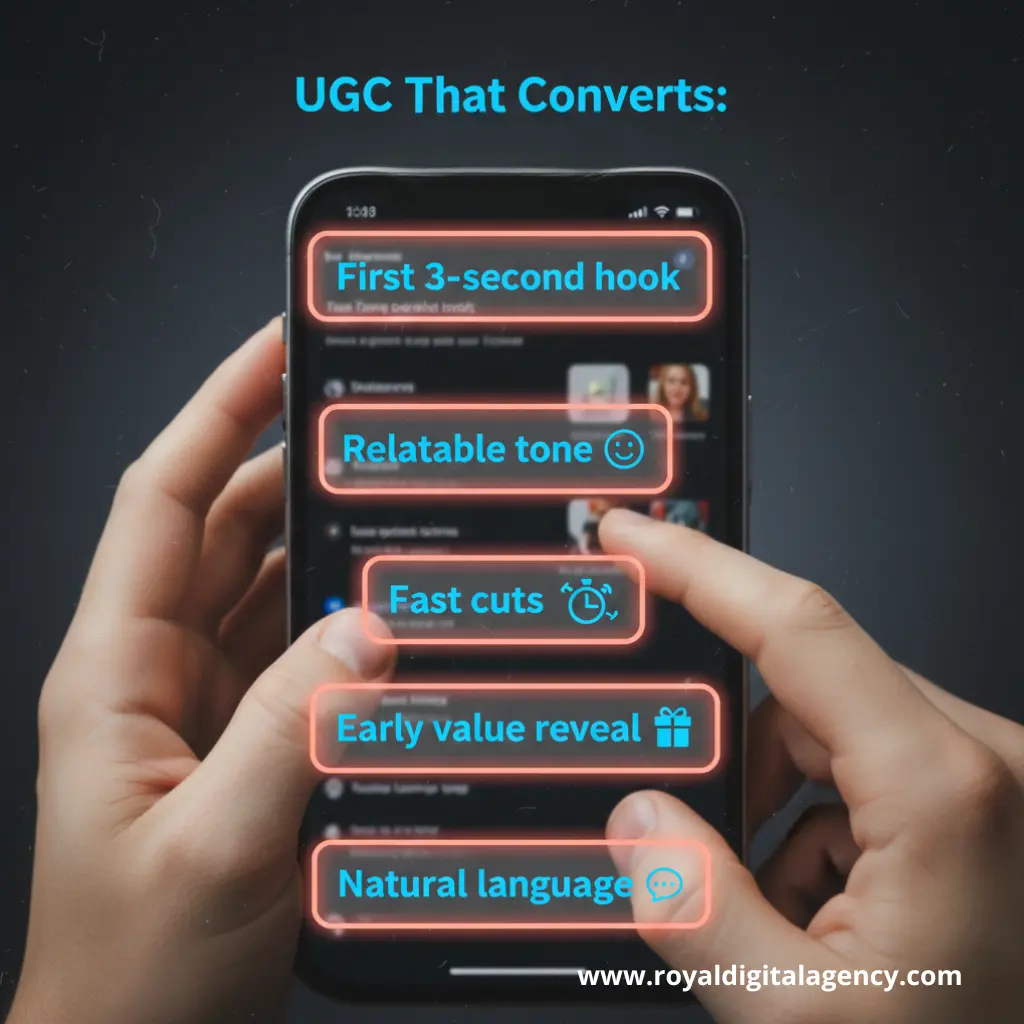
Everything depends on the first three seconds. A good hook is an assurance of relevance. This may be an audacious statement, an obvious issue, or an unexpected result. When viewers are not curious or do not instantly recognize, they scroll.
UGC is effective when the speaker is familiar. The content is believable in its simple language, daily tone and flawed delivery. It must sound like an actual human being who has something to say, and not a brand script.
The viewers desire evidence rather than assurances. Early presentation of the result creates trust and retention.
The most important factors that cause conversions:
Mobile feeds of short vertical videos.
Natural language and informal presentation.
Quick cuts which keep the viewing action going.
Clear benefits shown early
These trends are recreated at scale using AI-powered UGC platforms to assist brands in generating user-generated content that gathers attention, trust, and clicks.
In 2026, trust is the foundation of successful UGC for brands. With the emergence of AI-driven UGC systems, brands and creators should apply them ethically to safeguard their reputations and future effectiveness.
Most UGC platforms for creators grant commercial usage rights. Ownership in itself is however not sufficient. Brands should make sure that content is platform compliant and ethical.
The important points to address are:
User-generated content websites and AI UGC platforms are powerful tools, but misuse can damage brand reputation quickly. Ethical creation of UGC ensures trust in the audience, a better approval of ads, and sustainable development on modern content platforms.
User-generated content does not represent a fad. It is the manner in which individuals determine what to believe on the internet. The difference on how that content is made and scaled is in the year 2026.
The reason is that AI-driven UGC systems have altered the process, rather than the purpose. People will react to sincerity, transparency, and familiar anecdotes. What AI removes is friction. It eliminates time-consuming schedules, expensive and imaginative bottlenecks.
This is quicker testing, improved ad performance and simpler content production to brands. To creators, it is a way of increasing content scalability without burnout. AI UGC helps to keep authenticity when it is properly used rather than abolish it.
Strategy comes in here.
Royal Digital Agency helps brands choose the right UGC platforms, create converting UGC brand videos, and combine AI tools with real user-generated content websites when trust and scale both matter. The goal is not more content. It is aimed at improving content, which works.
If you want to use UGC for brands the right way, build a sustainable system, and stay ahead in 2026, Royal Digital Agency can help you get there. Let’s turn UGC into growth.
Influencer-like UGC is popular on AI avatar services such as Argent AI and Captions Mirage Studio. They enable creators to have a consistent appearance, voice and tone on videos. These websites are well suited to founders, educators, and personal brands who do not want to record content every day.
Speed and flexibility of formats are the most important to event promotion. The strong choices are Invideo AI and Creatify since they create short videos very fast and in the UGC style. These platforms are good with countdowns, highlights, speaker promos, and post event recap. Their social-first content works on Tik Tok, Instagram Reels, and paid advertising.
Yes, a number of AI UGC are regularly vetted on the educational purpose. Clear narration and expression delivery make Captions Mirage Studio popular because of structured lessons and tutorials. Argil AI is commonly applied by educators favoring a regular personal instruction. Such tools assist in increasing the learning materials without compromising clarity.
To new users, it has to be easy to use. Zeely AI and Invideo AI are considered user-friendly UGC platforms for creators. They provide directed working processes and easy editing and rapid generation. They are not required to have previous video experience, which is why they can be used by small brands and solitary creators.
Yes, the majority of AI UGC websites offer commercial usage of generated videos. Brands still should comply with the advertising regulations of such platforms as Meta and Tik Tok. Proposals should be not false and misguided. There should also be the use of licensed voices and avatars to ensure that there is no legal risk.
The AI UGC is not the substitute of real customer experiences. It complements them. AI is most suitable when it comes to speed, testing and initial campaigns. Real user-generated content websites are better for long-term trust and social proof. Most brands mix the two strategies to find a balance between the scale and credibility.
Findings can manifest themselves soon. Unless otherwise, many brands receive engagement or ad performance indications between 24 and 72 hours. Nevertheless, optimization typically involves testing various hooks and formats, and takes one to two weeks. The AI UGC sites enable quicker testing based on the creation of numerous variations with ease.
E-commerce, SaaS, education, events, and dropshipping are some of the most effective uses of AI UGC. Such industries require high content modifications and rapid testing. Artificial intelligence applications can lower the cost of production and retain the native forms of content that consumers are familiar with on the platform.





Let’s talk about how to take your product’s digital experience to the next level.


