


Nearly 77% of patients now use the internet before making a medical appointment, according to healthcare consumer research. This means your website often becomes the first interaction patients have with your clinic or hospital. Before they speak with a doctor or receptionist, they judge your credibility through your website.
Think about someone in need of emergency treatment or recovery treatment. They may be stressed or worried or in pain. In those moments, a slow or confusing website can cause them to leave and choose another provider.
That is why Medical Website Design is no longer just about appearance. It should help the patients to quickly get an idea of your services, trust your expertise and book an appointment with confidence.
In this guide, you will learn how healthcare web design and medical doctor Website design & Develop can turn website visitors into patients, especially for recovery centers, urgent care clinics, and emergency medical services.
Medical website design refers to creating sites specifically for healthcare providers that help patients understand services, trust professionals, and schedule appointments online.
Strong healthcare web design prioritizes patient experience, mobile usability, clear treatment information, and fast appointment booking. The goal is not just to present information, but also to encourage the patients to contact the clinic or make an appointment.
Modern medical doctor website design also includes SEO optimization, secure data protection, and accessibility features so every patient can access information easily.

Patients today are very different than a decade ago. Instead of directly going to the clinics, they often start their journey using a search engine.
Research from Google shows that over 70%Percent of patients read multiple provider websites before making a decision. They compare services, read reviews and critique credibility.
During this process of evaluation, patients usually pay attention to a number of signals.
• Doctor qualifications and experience
• Treatment explanations and service pages
• Patient testimonials and reviews
• Website professionalism and usability
• Appointment booking convenience
For emergency or recovery services, decisions are made at a much faster pace. A patient searching for urgent care may spend only a few seconds evaluating a website.
This means your medical website design must communicate trust instantly.
The best healthcare sites guide patients smoothly from curiosity to action. Clear navigation, reassuring content and strong calls to action all have an impact on patient decision-making.
When done correctly, best medical website design creates a seamless journey from search to appointment booking.
Imagine if you walked into a hospital and it had broken lights, cluttered desks and confusing signs. Most patients would immediately be suspicious of the quality of care.
Your website works exactly the same way.
Healthcare experts often describe websites as the digital front door of a medical practice. It is the online equivalent of your waiting room.
A well‑designed healthcare website creates a calm and trustworthy experience. Patients feel reassured when they are presented with a professional layout, information and welcoming visuals.
Strong medical doctor website design usually includes:
• clean page layout
• calming color schemes
• clear headings and readable text
• real images of doctors and facilities
These elements might appear to be small but have a great impact on the way the patient perceives your clinic.
For recovery services, this is even more important. People in need of rehabilitation or therapy often suffer from a sense of being vulnerable. A thoughtful design can help to let them know that they are in the right place.
That is why many of the best healthcare sites prioritize emotional comfort along with functionality.
Effective medical website design follows proven principles that help patients quickly understand services, trust providers, and confidently book appointments.
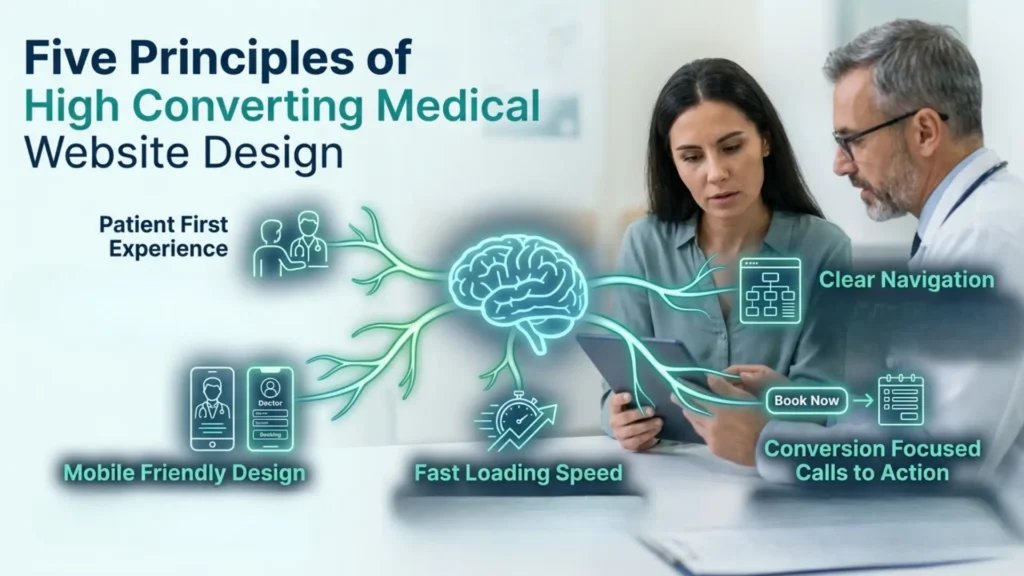
Successful healthcare web design begins by prioritizing patient needs over internal clinic structure. Visitors should get to know services offered, doctor expertise, and booking options instantly and without any confusion.
Best medical website design organizes content logically so patients easily find treatments, doctor profiles, contact details, and emergency information without navigating complex menus or searching multiple pages.
Modern medical doctor website design must perform perfectly on smartphones. Most patients are searching healthcare services via mobile devices, so it is necessary to have responsive layout to be accessible and also engaging.
Speed has a major effect on patient behavior online. Best medical web page design ensures pages load quickly, reducing bounce rates while improving user experience and search engine visibility.
High converting medical website design strategically guides visitors toward action. Clear calls to action such as book appointment, call clinic or request consultation, increase patient inquiry.
A high performing healthcare website must offer more than information. It should benefit patients to interact easily with the clinic. Modern healthcare web design includes several essential features that improve usability and conversions.
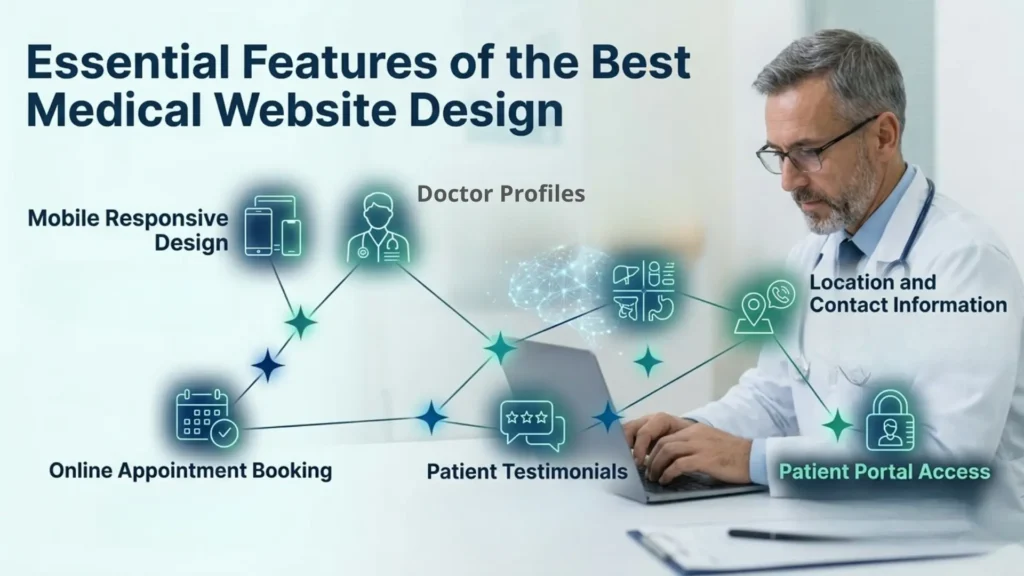
Most of the patients search out doctors through their phones. A responsive design is a design that automatically adjusts to different screen sizes to make visitors comfortable when browsing.
Patients increasingly expect to schedule appointments directly from websites. Studies show that 68 percent of patients prefer providers that offer online bookings.
Professional doctor profiles help to build credibility. These pages should contain qualifications, certifications, years of experience and areas of specialization.
Patients desire explanations of treatments and procedures. Dedicated pages help them know the benefits, recovery process and expected results.
Easy access to phone numbers, maps, and directions are necessary for emergency care providers.
Many of the best healthcare sites now offer portals where patients can access records, communicate with doctors, and manage appointments.
Together, these features form the foundation of effective medical doctor website design that supports patient convenience and trust.
User experience is a big factor in the process of converting visitors into patients. A website that is difficult to use can drive potential patients away within seconds. Google research shows that 53 percent of mobile users abandon websites that take more than three seconds to load.
One of the most important principles of UX is simple navigation. Patients should be able to access important pages within two clicks.
Another essential factor is Website Speed. Fast loading pages result in better engagement and reason why they come back for more services.
Clear calls to action are also absolutely important. Buttons such as:
• Book Appointment
• Call Now
• Schedule Consultation
• Get Emergency Care
should be seen throughout several pages.
Readable typography is also important. Many patients visiting healthcare websites may be older adults. Large font and high contrast are made for better accessibility.
Effective UX design transforms medical websites from simple brochures into powerful patient acquisition tools.
Healthcare decisions are based on a lot of trust. Patients need to have confidence in the clinic or doctor's qualifications and reliability. Strong medical website design uses several strategies to build credibility.
Reviews and success stories provide social proof that treatments work. Hearing positive feedback from actual patients encourages new visitors to make consultations.
Generic stock photos can make a website feel impersonal. High quality images of real doctors, nurses and facilities form a greater emotional connection.
Display certifications, affiliations and awards. This helps to reassure patients of medical expertise.
Helpful blog posts and treatment guides establish authority as well as good SEO visibility.
For Example: A physical therapy clinic might publish articles on recovering from back pain, or rehabilitation exercises, in order to attract search traffic and become a source of trust.
This blend of visual credibility and educational resources is a hallmark of the best healthcare sites and best Medical Website Design Practices.
Landing pages are extremely important in healthcare marketing. Instead of directing visitors to a non-specific homepage, clinics have specialized pages for specific treatments. Recovery centers commonly have recovery center pages that include the following services:
* addiction rehabilitative programs
* physical therapy recovery
* mental health treatment
* post surgery rehabilitation
Emergency care providers focus on pages for urgent care such as trauma treatment or 24 hour clinics.
An effective landing page will generally have:
* an explanation of the problem that is easy to understand
* the available treatment options
* expertise and qualifications of the doctor
* patient testimonials
* a prominent appointment booking button.
Such way patients quickly learn whether a clinic can help them.
Effective landing pages are a key component of medical website design strategies used by high‑performing healthcare organizations.
Recovery centers and emergency providers have unique website requirements compared to general clinics.
Patients who are looking for these services may be in pain, anxious or have other pressing concerns. The site has to provide information quickly and clearly.
Important design elements are including
- emergency contact numbers that are visible
- fast loading pages for an urgent access
- location directions which are integrated with maps
- easy to use appointment request forms
- easy to understand description of recovery treatments
For example, a rehabilitation clinic may promote addiction recovery programs, therapy options and support resources directly on the homepage.
Emergency care providers often make call buttons as well as directions available for patients to contact the clinic immediately.
These design strategies help ensure the website supports patients during critical moments.
Even the best healthcare website will not generate patients if people cannot find it online.
Search engine optimization is a process that helps clinics rank in search results when patients are searching for care. Local search is particularly important in the case of medical services. Patients often do searches using phrases such as:
* urgent care near me
* emergency clinic near me
* drug rehabilitation center near me
To capture this traffic, healthcare websites must optimize several elements.
* location-based Keywords in services pages
* clinic name, address and phone information consistent
* an optimised Google Business Profile
* educational blog content that catch questions of patients
For example, a recovery center in Los Angeles may develop content for addiction treatment options in Los Angeles.
These strategies help clinics rank better in area searches and provide the local area with patients.
SEO combined with strong design is what allows the best medical web page design to generate continuous patient inquiries.
Healthcare websites must meet strict standards for accessibility and data security. One requirement of importance is ADA accessibility compliance. Websites should be usable by people with disabilities. This includes:
* compatibility with screen readers
* clear text contrast
* keyboard navigation alternatives
Another requirement, which is essential, is HIPAA compliance. Patient information submitted through forms must be securely kept and protected. Secure websites also use SSL certificates to encrypt communication between the user and the server.
Beyond the fact that these practices are required by law, they make for better patient trust. Visitors feel more confident sharing personal information when they know the website protects their privacy.
For this reason, accessibility and security are fundamental parts of best medical website design practices.
Many healthcare websites lose potential patients because design and usability mistakes create confusion, reduce trust, and make booking appointments difficult for visitors.
Outdated Design: An outdated layout will make clinics look less professional and unreliable. Patients often equate old design styles, poor visuals and cluttered pages to lower healthcare quality.
Slow Loading: Slow loading pages are frustrating to visitors and increase bounce rates. Patients searching for urgent services rarely wait for slow websites, often choosing faster competitor sites immediately.
Poor Navigation: Confusing menus and complex page structures mean that visitors don't quickly find the doctor information, service or contact details they need and can easily be put off from scheduling an appointment.
Weak Mobile Design: Websites that are difficult to read or navigate on smartphones lose significant patient traffic, since most healthcare searches today occur on mobile devices.
Missing CTAs: Without clear calls to action such as 'Book Appointment' or 'Call Clinic' visitors can read information but do not take the next step.
Thin Content: Limited service explanations, missing doctor profiles, and lack of educational content reduce credibility, preventing medical website design from building trust and attracting patients online.
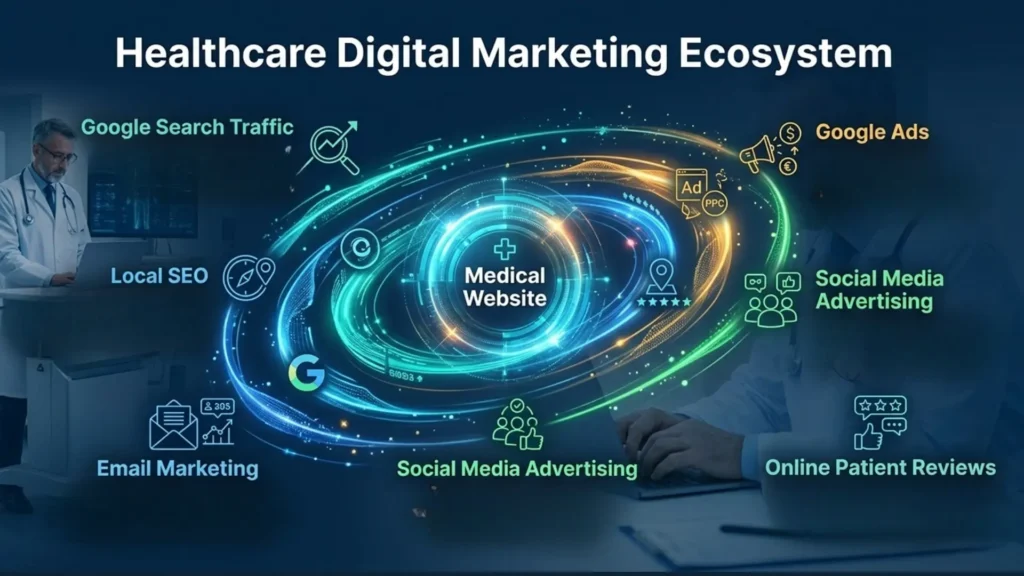
A healthcare website works best when it is integrated with a broader Digital Marketing strategy.
Marketing channels such as Google Ads, social media campaigns, and email newsletters often drive traffic to the website. Once visitors arrive, the website must guide them toward booking appointments.
This is why modern healthcare marketing focuses on conversion‑focused healthcare web design rather than simple informational pages. The website becomes the central hub connecting all marketing efforts.
Here are some common clues that your clinic may benefit from a fresh website.
• The website is over five years old
• Pages load slowly if you are using a mobile device
• Patients are unable to locate the appointment booking option easily
• The site does not appear in local healthcare search results
• Navigation seems confusing or difficult to use
Modern healthcare websites prioritize speed, a smooth patient experience, and clear explanations of services. Updating your medical‑doctor website can boost both online visibility and the number of patient inquiries.
Healthcare technology continues evolving rapidly, and modern medical website design is transforming how patients discover, trust, and connect with providers online.
These innovations will keep advancing the future of best medical web page design, helping providers deliver better digital experiences and attract more patients online.
Use this quick checklist to evaluate whether your healthcare website is ready to convert visitors into patients.
- mobile‑friendly healthcare web design
- fast loading performance
- Online appointment booking system
- clear doctor profile pages
- detailed treatment and service pages
- visible contact information and directions
- testimonials of patients and signals of trust
- SEO Optimized content to search for local
- HIPAA-compliant patient forms
If your site lacks these features, upgrading your medical doctor website design can significantly improve engagement and bookings.
In the healthcare sector, a website must do more than look professional. It must attract new patients, build trust and lead visitors to book an appointment. Royal Digital Agency is one of the best agencies for developing websites that provide these outcomes.
With over ten years of specialized experience in healthcare website development, our team knows how patients search for care, compare providers, and decide where to book online. We focus on high‑converting healthcare web design, including medical doctor site builds that support steady patient growth.
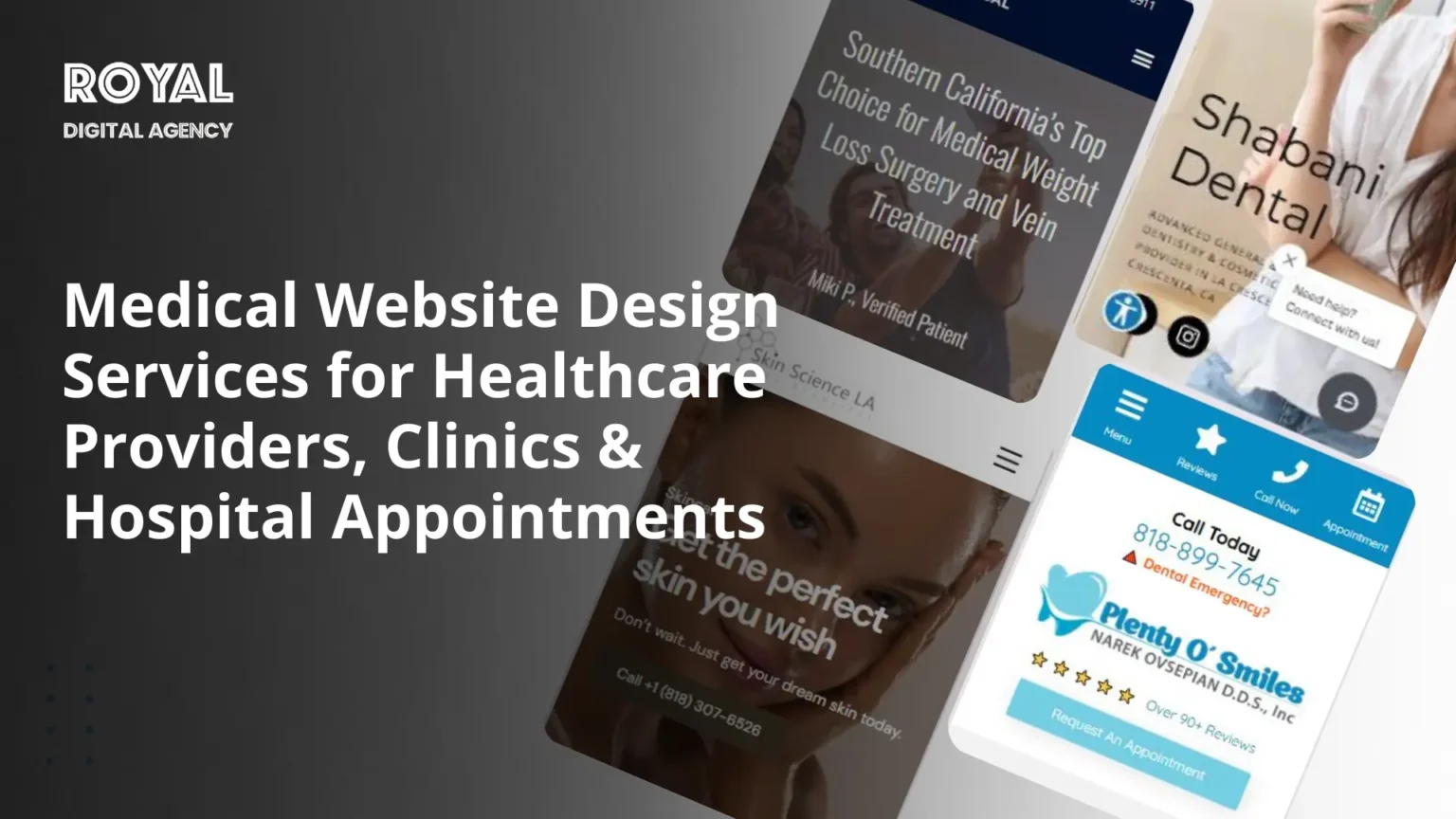
Royal Digital Agency has been working with reputable medical practices including West Medical, SGS Dental, PlentyOSmiles, Dr. Golshani and many others from California.
For over a decade, we've worked with clinics to redesign the outdated clinics into modern patient acquisition sites. From urgent care centers to dental offices, wellness facilities to recovery facilities, we know the digital journey that patients make before determining which provider to choose. This insight lets us craft medical website strategies that boost online visibility and increase patient inquiries and bookings.
Our approach is a combination of design, marketing and patient psychology. Instead of simply building a website, we create a comprehensive medical website design strategy that focuses on patient conversions and long‑term growth.
Our healthcare website solutions include
- professional medical website design and development
- high-converting medical web page design including optimized UX
- Local SEO for healthcare websites to help them rank during local searches
- Patient acquisition Google Ads and paid search campaigns
- social media advertising strategies that yield qualified leads
By combining design and SEO and paid media methods, we help providers to attract the right patients and boost appointment bookings.
Our goal is simple: build the best healthcare sites that look professional, generate real patient inquiries, and produce measurable business growth.
Medical websites are now one of the most powerful tools for attracting and converting patients. A well structured healthcare site helps visitors quickly locate information and build trust in the clinic and schedule an appointment.
Strong medical website design combines clear navigation, mobile optimization, educational content, and local SEO strategies.
When these elements are used in conjunction with one another, a site becomes more than an online brochure. This becomes a reliable system that brings new patients to the practice on a constant basis.
Healthcare providers who invest in professional medical doctor website design will be better positioned to grow their practice and serve patients effectively in the digital age.
SEO is very important because the majority of patients will search online before choosing a doctor or clinic. Properly optimized medical sites come up when users search for services such as "urgent care near me" or "rehabilitation center near me." Good SEO increases visibility, draws in local patients and results in booking appointments.
The timeline is reliant on pages, features and the complexity of the design. A normal medical doctor site takes four to eight weeks. More complex projects - e.g. SEO, appointment systems, patient portal - could take longer.
Successful designs focus on patient experience, communicating services clearly, loading quickly and having strong calls to action. They also include doctor profiles, patient testimonials and easy online booking to convert visitors to patients.
Yes. When a site is well optimized combined with local SEO, it can attract local patients. Targeting location-based keywords and optimizing Google Business profiles help the site to appear in the local search and generate steady inquiries.
Regular updates allow for keeping the performance and accuracy high. For the most part, most experts advise to review design, content, and SEO every six to 12 months. Updating blogs, doctor profiles, and information on treatments helps keep up the visibility of the search and the trust of the patients.
Mobile design is essential because many patients try to find doctors on smartphones. A mobile-friendly site allows users to easily read information, locate services and make appointments on any device.





Let’s talk about how to take your product’s digital experience to the next level.


